The present is the future at its point of greatest possibility.
Every consequential choice changes the organization that makes it, and it changes the conditions for the choice that follows. Strategy is the discipline of shaping that possibility on purpose.
Written for founders, executives, strategists, board members, and the people leading a transformation, who must commit people, money, and attention while customers shift, competitors move, and the outcome is still uncertain.
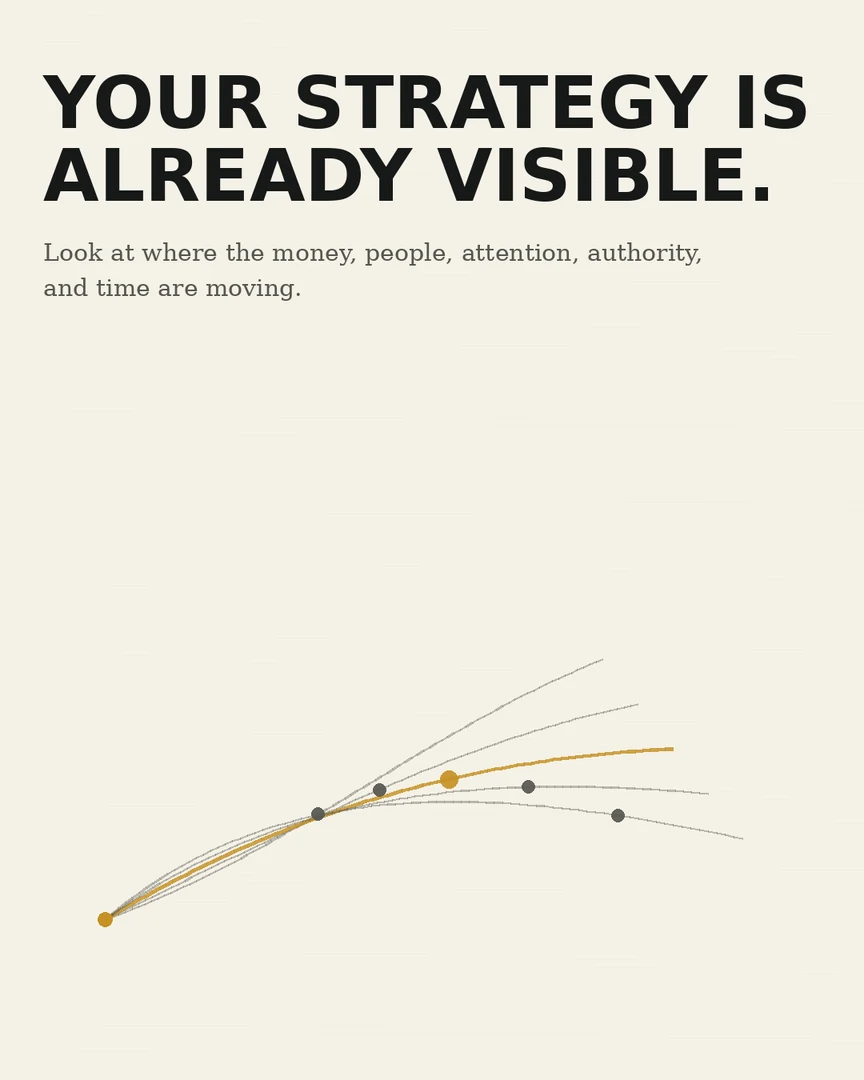
From the field notes, #PossibilityInFormation
Consequential choices in turbulent times
The next move cannot wait
for the uncertainty to clear.
Customers change what they value. Competitors make moves. Technologies and capabilities evolve. Investment decisions cannot wait until every uncertainty is resolved.
Leaders making consequential choices under these conditions need a better way to understand the strategic environment, choose where to commit people, money, and attention, and adapt as the consequences become visible.
Strategy Is the Making is a book about strategic foresight and adaptive strategy, written for the question those leaders face: How do we make sense of what is changing, choose our next move, and keep adapting in order to win?
One decision changes the next
Strategy happens
in the making.
An organization is shaped by what its people do next. What they do next is shaped by what they have already done. Budgets, roles, routines, and promises carry the weight of earlier choices, so every move in the market also changes the organization that has to make the next one.
The book connects strategic work with the organizational capacity to perform it repeatedly. Adaptable operating models are part of that capacity: they allow knowledge to inform decisions, decisions to direct resources, and learning to change action.
Leaders commit people, money, and attention to a move before every uncertainty is resolved.
The choice changes roles, routines, expectations, and what the organization knows. Customers and competitors answer it, and the field shifts.
The organization reads what the last move revealed, and that learning changes the next action.
Inside the book
The book moves through seven capabilities in sequence, the way a suite moves through its parts. In an organization, they all play at once.
Make sense of change. Notice when the categories the organization relies on stop fitting, perceive the shift while it is still forming, and connect what different parts of the organization know, so a signal at the edge of the market reaches someone with the authority to act on it.
Understand the terrain, then choose and act coherently. Map the situation, find the crux, and commit with incomplete information. Work with the different clocks on which customers, competitors, and the organization move, and choose when to act.
Adapt to win. Carry the choice into the operating model, retire what no longer fits, and renew the organization’s capacity to keep competing as conditions change.
Meaning has a habit of arriving after experience.
From the Introduction
Begin with an idea
Each idea opens on a situation
leaders already know by feel.
When the instruments measure themselves
Internal consistency can conceal a change in the world outside.
Read the idea 02 / MakingThe organization has a grain
Earlier decisions live on in the structures that shape present action.
Read the idea 03 / TimeOrganizations run on several clocks
Some parts change in a week and others take years. Strategy has to hear both.
Read the ideaThe Interludes · Second edition
Every recording in the book, drawn at the size of a word.
Jazz offers a distinctive way to understand the work of strategy: preparation, timing, and distributed attention while the outcome is still open. The Interludes is a companion volume to the book. Every recording the chapters discuss has its own plate: the mark drawn from the record, the lesson the chapter takes from it, and the place it takes in the book.
- I
- II
- III
- IV
- V
- VI
- VII
Bring a decision to the conversation
The book is a beginning.
The conversation continues.
- What arrives
- One field note at a time: an image, a short observation about a signal in the market or a choice in front of a leadership team, and a question to carry into the decision you are facing now.
- How often
- Twice a week. The opening sequence runs to nine notes, from 21 September to 20 October. After that, you hear from Will when there is a new note or news of the book.
- When
- On the day each note is posted. Every email carries a one-click unsubscribe.