Field notes · #PossibilityInFormation
Field notes
Short notes on strategic foresight and adaptive strategy. Each one takes a signal from a changing environment and turns it into a question for the leaders who have to choose what to do about it.
The latest note · Tuesday, October 20
The sequence so far
Each note began as a post and asks one question.
9 of 9 notes published.
- 01Monday, September 21
The present is the future at its point of greatest possibility.
Organizations often treat the future as a destination to forecast. That framing misses the strategic work already underway.
The future is being formed through the conditions, relationships, and commitments of the present. Small changes in attention, authority, time, or connection begin shaping what becomes possible before a plan records them.
The present carries strategic consequence because it contains more possible futures than an organization can pursue. Every commitment gives some of those possibilities greater form.
Over the coming weeks, I will be exploring how organizations learn to notice those possibilities, interpret emerging patterns, and take responsibility for what their choices are already making.
The question
Which condition in your organization may be shaping more than you can currently see?
- 02Thursday, September 24
What becomes possible depends on what we learn to notice.
Attention is an allocation decision. It determines which signals receive time, legitimacy, inquiry, and eventually resources.
Most organizations contain more information than their prevailing story can hold. The practical question is which observations receive sustained attention long enough to change that story.
A weak signal gains strategic value when someone can connect it to changing conditions, recurring evidence, or a consequential choice.
The question
What are you noticing that your current account cannot yet explain?
- 03Monday, September 28
Something small changes. The field is no longer the same.
Strategic change often begins before the organization has language for it. A local condition shifts. A relationship changes. A decision redirects attention. The surrounding field starts responding.
The first task is to see the change clearly enough to ask whether it is isolated, recurring, or connected to other movement. Premature certainty closes the inquiry. Disciplined attention keeps it useful.
The question
Which small change could alter the relationships around it?
- 04Thursday, October 1
What are you seeing that does not yet fit the story?
An anomaly matters because it marks the limit of the current explanation. It tells us that the story guiding attention and action has stopped accounting for part of the field.
The useful response is inquiry. Which fact has been excluded? Which relationship has changed? Which assumption now carries more uncertainty than the organization acknowledges?
The question
What no longer fits your organization’s story?
- 05Saturday, October 3
A signal becomes strategic when someone learns to notice it.
Novelty can bring a signal into view. It becomes strategic when someone gives it enough continuity to be examined against context, consequence, and choice.
That work requires disciplined attention. Record the observation. Test whether it recurs. Ask which relationships it could change. Identify the decision that would become necessary if the signal strengthens.
The question
Which signal deserves sustained attention?
- 06Thursday, October 8
Today’s anomaly may begin tomorrow’s pattern.
Many consequential changes in a market show up first as something that does not fit. A customer uses the product in an unexpected way. A competitor makes a move that looks like a mistake. A supplier's price falls faster than the forecast allowed.
One irregularity invites attention. When it recurs, it becomes evidence, and evidence deserves interpretation before it reaches the dashboard.
Interpretation is where strategic foresight earns its place. The team has to ask what connects the observations, which conditions could sustain the pattern, and which decision would change if the pattern strengthens.
A team that waits for the quarterly report gets certainty after the window to act has narrowed. A team that makes sense of the pattern early can choose its move while the move still matters.
The question
Which recurrence in your market deserves interpretation this week?
- 07Monday, October 12
What looked isolated now belongs to a pattern.
Earlier evidence changes meaning when its relationship to the market becomes visible. The first odd observation becomes a reference point. Each recurrence adds continuity. A change in context shows what the pattern could cost or create.
Many leadership teams already have that evidence. It sits in sales notes, support tickets, a field engineer's comment, and a lost deal, each filed as an exception. A team that looks again across those sources can often find a pattern that was present from the start.
This is orientation: the work of deciding what the situation is before deciding what to do about it. A team that orients well can see moves its competitors have not yet noticed.
Once the pattern is visible, the strategic question is what it should change in where your people, money, and attention go.
The question
What changed when you looked again?
- 08Thursday, October 15
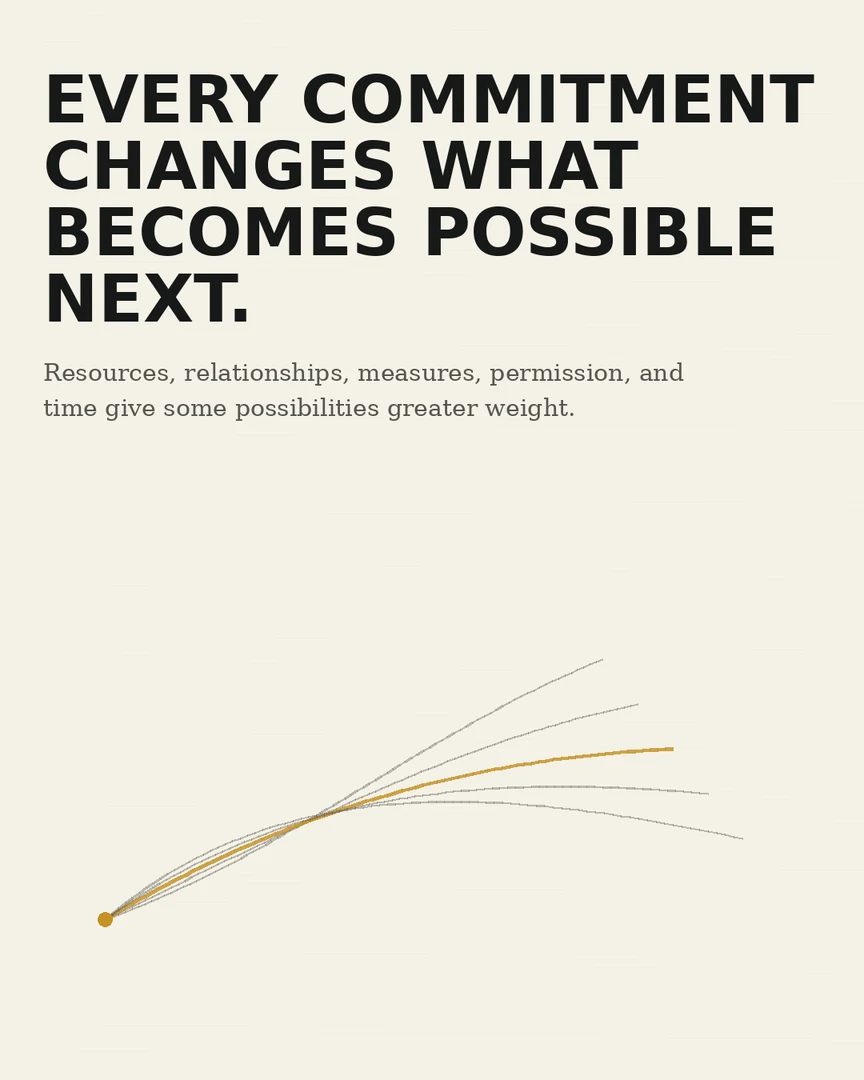
Every commitment changes what becomes possible next.
Making sense of the market matters because sooner or later a team has to commit.
A commitment changes the field because it gives one possibility real support. Money moves. People receive authority. Time becomes available. Measures reward one direction. Relationships gain continuity.
Each commitment makes some futures more reachable and others less so, for you and for the competitors who respond. Strategy becomes visible in these accumulations long before it appears in a strategy planning document.
Make sense of the situation, then make your move. The quality of the second depends on the first.
The question
Which current commitment is changing what becomes possible next for your organization?
- 09Tuesday, October 20
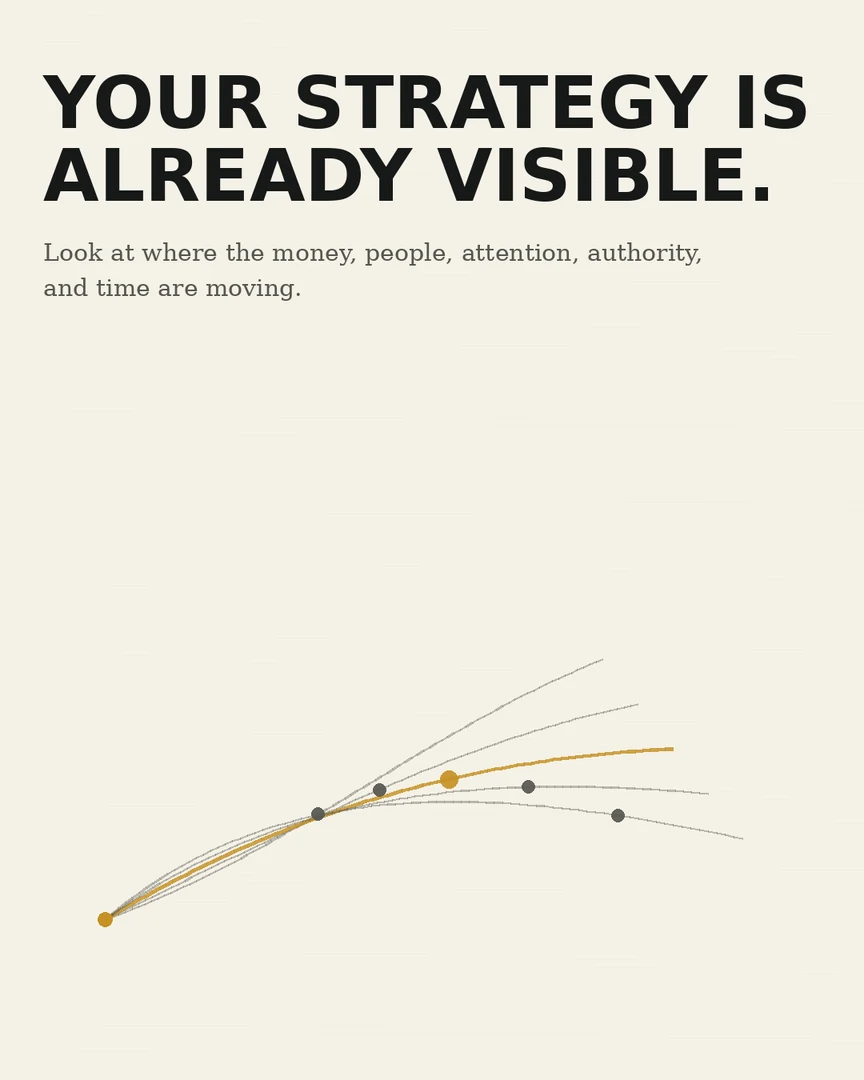
Your strategy is already visible.
Open last quarter’s budget. Look at your last five hires. Read the agendas of your last three leadership meetings. Ask who can spend money without asking anyone first.
Those four records show where your people, money, and attention went. When they disagree with the strategy deck, the records are usually right.
My forthcoming book, Strategy Is the Making, treats strategy as two crafts: making the choices and trade-offs, and making the conditions in which people can make them well.
The question
Which record would surprise your leadership team most?
Follow the sequence
Receive each new field note by email.
- What arrives
- One field note at a time: an image, a short observation about a signal in the market or a choice in front of a leadership team, and a question to carry into the decision you are facing now.
- How often
- Twice a week. The opening sequence runs to nine notes, from 21 September to 20 October. After that, you hear from Will when there is a new note or news of the book.
- When
- On the day each note is posted. Every email carries a one-click unsubscribe.
Your address is used only for the field notes and news of the book. Privacy. Writing in about something else? Contact