Chapter 02
Patterns in the Storm
Jazz Interlude · 03
Bill Evans Trio
Autumn Leaves
Bill Evans Trio. “Autumn Leaves,” on Portrait in Jazz. Riverside RLP 12-315 (mono) and RLP 1162 (stereo), 1960. Recorded at Reeves Sound Studios, New York, 28 December 1959. Evans (piano), Scott LaFaro (bass), Paul Motian (drums). Composed by Joseph Kosma. The mono and stereo editions of the original release carry different takes.
A dashboard shows the stocks and hides the feedback
The lead belongs to whoever has something to say, and it can change hands inside a bar.
Listen
Recorded at Reeves Sound Studios, New York, on 28 December 1959.
The trio taped “Autumn Leaves” at Reeves Sound Studios on 28 December 1959, with Orrin Keepnews producing and Jack Higgins engineering, and Portrait in Jazz went out with different takes on the mono and the stereo pressings. Two complete performances of the same tune by the same three players on the same afternoon were issued on the same album under the same title. Neither one is the definitive take. What the two share is the tune, and what makes each of them worth hearing is what they do not share.
The Bill Evans Trio shows how little instruction a band actually needs. A bandleader calling this tune might say: “Autumn Leaves. G minor. Medium swing.” Everything after that is assumed: thirty-two bars, head in, solos, head out.
Listen for
The freedom is audible because the preparation is not.
The roles keep moving
Everyone on the stand knows the melody and the harmonic framework, and that shared knowledge is the intent. Within it, roles shift constantly. Evans provides harmonic direction while Scott LaFaro and Paul Motian participate fully in making the music. The bass sometimes leads. The drums sometimes make melodic statements. The piano sometimes drops into pure accompaniment.
Simultaneous improvisation
The hierarchy keeps shifting according to who has something to say and who needs support at that moment. Evans described what he wanted as simultaneous improvisation rather than one soloist at a time over an accompaniment, and Michael Mackey’s study of these sessions treats that interplay as the trio’s real subject. Coherence emerges from the relationships among the parts instead of from a controlling center.
What preparation makes possible
You cannot plan that into existence. You can practice the capacities that make it possible. The trio could improvise together because its members had built a shared vocabulary, mutual trust, and complementary skills, and had internalized the intent deeply enough to respond in the moment without losing coherence. The feedback among them ran faster than conscious deliberation. The freedom is audible because the preparation is not.
The trio had eighteen months left when it made this record. Scott LaFaro died in a car accident on 6 July 1961, at twenty-five. The trio’s way of playing survived him in the sense that other bassists learned it and other groups adopted it, and the particular three-way conversation on this record did not survive him at all. Capability transfers between people. A specific set of relationships does not.
Capability transfers between people. A specific set of relationships does not.
From Chapter 02, “Patterns in the Storm”
The playbook and the trio
What can be written down is the intent and the shared reference points.
Organizations that want a high-trust team’s capability copy its processes, practices and policies into playbooks and standard operating procedures. No playbook can copy the relationships among the people, so the copy loses the trust and the reaction time that made those practices work. What can be written down is the intent and the shared reference points. What has to be built through repetition is the part that lets three people change roles inside a single bar without discussing it.
Directed opportunism, the military historian and strategy consultant Stephen Bungay’s term that Chapter 06 develops, names the combination: strategic intent shared in common, and freedom of action for whoever can see the situation most clearly at the moment it changes. This trio is a working model of it at a scale of three people and thirty-two bars. Scaling it up is genuinely hard, and the mechanism does not change with the scale, which is that the intent has to be specific enough to coordinate and loose enough to leave the response open.
The two issued takes are a warning about documentation. Anyone asked to write down how this trio played “Autumn Leaves” would have to pick one of them, and picking either would record as a rule something the players treated as one option among several available that afternoon.
The lesson: The lead belongs to whoever has something to say, and it can change hands inside a bar.
The mark · II · 03
In the making
Chapter 02 places the record in “A dashboard shows the stocks and hides the feedback.” Hierarchy shifting inside a bar. The bass leads, the drums make melodic statements, the piano drops to accompaniment, and the roles move according to who has something to say. Two complete takes from the same afternoon were issued on the same album, so neither is the definitive take.
The mark
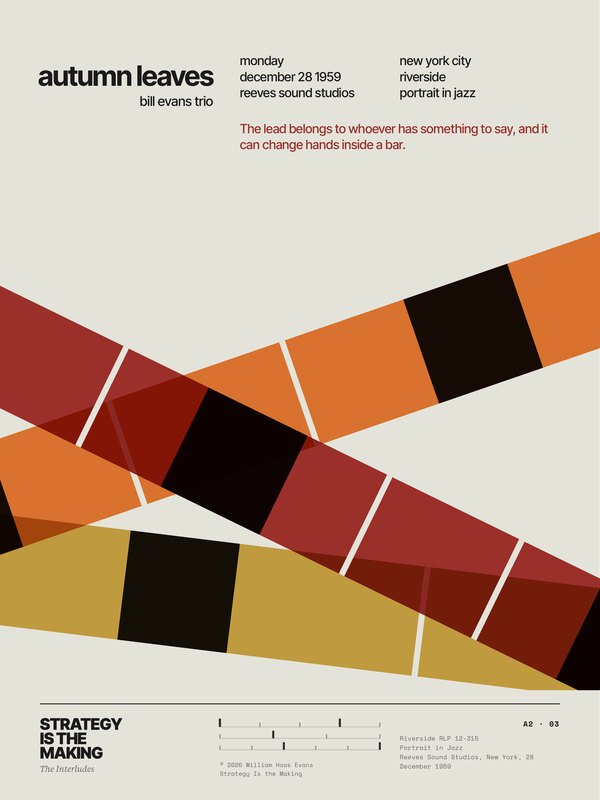
Three registers phrasing against one another. The bass sometimes leads and the piano sometimes drops into pure accompaniment.
The music
The bass sometimes leads. The drums sometimes make melodic statements. The piano sometimes drops into pure accompaniment.
From The Interludes. Position along the line is time and height is stress. How to read a mark · Download The Interludes (PDF)
The poster
The lead belongs to whoever has something to say, and it can change hands inside a bar.
The record
Bill Evans Trio. “Autumn Leaves,” on Portrait in Jazz. Riverside RLP 12-315 (mono) and RLP 1162 (stereo), 1960. Recorded at Reeves Sound Studios, New York, 28 December 1959. Evans (piano), Scott LaFaro (bass), Paul Motian (drums). Composed by Joseph Kosma. The mono and stereo editions of the original release carry different takes.