Chapter 04
Navigating Uncertainty
Jazz Interlude · 03
Sonny Rollins
Blue 7
Sonny Rollins. “Blue 7,” on Saxophone Colossus. Prestige PRLP 7079, 1957. Recorded at Van Gelder Studio, Hackensack, New Jersey, 22 June 1956. Rollins (tenor saxophone), Tommy Flanagan (piano), Doug Watkins (bass), Max Roach (drums). Composed by Sonny Rollins. Approximately 11:17.
VIII · Know the kind of situation before choosing a method
Judge a probe by what comes back, because the intention read into a result is a guess.
Listen
Recorded at Rudy Van Gelder’s studio in Hackensack on 22 June 1956.
Sonny Rollins recorded “Blue 7” on tenor saxophone on 22 June 1956 at Rudy Van Gelder’s studio in Hackensack, New Jersey, for Prestige. Bob Weinstock produced and Van Gelder engineered. Tommy Flanagan played piano, Doug Watkins bass, and Max Roach drums. The track ran eleven minutes and seventeen seconds and closed the album issued as Saxophone Colossus.
Listen for
What a listener can hear survives the correction intact.
The figure
The material is a twelve-bar blues in B flat at about 134 beats to the minute, which is a form every player in the room would have known cold. Rollins takes five choruses on his first solo. He works a compact figure, turns it, displaces it, alters its contour, and lets each variation propose the next. Flanagan and Roach take choruses of their own. Nothing about the harmonic material is unusual, and musicologists have been arguing about the solo for nearly seventy years.
Schuller’s reading
The argument began with the composer and critic Gunther Schuller. His essay “Sonny Rollins and the Challenge of Thematic Improvisation” appeared in the first issue of The Jazz Review in November 1958 and was collected in Musings by Oxford University Press in 1986. Schuller argued that Rollins had developed the motivic material of a theme across the solo, which gave the performance a formal coherence critics had been claiming jazz improvisation could not achieve. The essay set the terms for how the record was heard for the next half-century.
Givan’s test
Tested against the artifact, the argument failed. Writing in the Journal of the American Musicological Society in 2014, the musicologist Benjamin Givan concludes that Schuller’s principal claim “is false,” that “Blue 7” was improvised in its entirety, and that the pattern Schuller identified as a thematic motive was one of Rollins’s habitual improvisational formulas, audible on many of his other recordings from the 1950s. The evidence is comparative: the same figure turns up elsewhere in Rollins’s playing, where no theme exists for it to develop.
The two readings disagree about intention. Schuller described what Rollins was doing. Givan examined what the recordings contain and showed that the observable pattern has another explanation. Both scholars heard the same eleven minutes. The dispute is about whether a listener can infer a compositional method from a result, and the answer the recordings give is no.
Intent that has to be inferred from the result cannot be taught, audited, or repeated.
From Chapter 04, “Navigating Uncertainty”
Probes and intentions
A probe, a small action taken to disturb a signal and learn from the response, is judged on that ground too: its value lies in what comes back.
What a listener can hear survives the correction intact. A small unit of material recurs, supplies continuity, and arrives altered on each return. Those alterations accumulate into eleven minutes that cohere without a written plan. Whether the figure was chosen for the occasion or came out of Rollins’s standing vocabulary changes the account of how it happened, and what it does stays the same. A probe, a small action taken to disturb a signal and learn from the response, is judged on that ground too: its value lies in what comes back.
The first reading made the performance admirable for the wrong quality, which was compositional intent, and set a standard that improvisers were then measured against. Givan’s account leaves a plainer achievement in place: a player with a large vocabulary, working a familiar form, made choices in real time that cohere on inspection. That is a more useful model for an organization, because it describes something a team can build toward. Intent that has to be inferred from the result cannot be taught, audited, or repeated.
The lesson: Judge a probe by what comes back, because the intention read into a result is a guess.
The mark · IV · 03
In the making
Chapter 04 places the record in “VIII · Know the kind of situation before choosing a method.” A result tested against the intention read into it. A compact figure recurs and arrives altered on each return, producing eleven minutes that cohere without a written plan. A scholarly argument that the coherence proved compositional intent was tested against the recordings and failed, and what a listener can hear survives the correction intact.
The mark
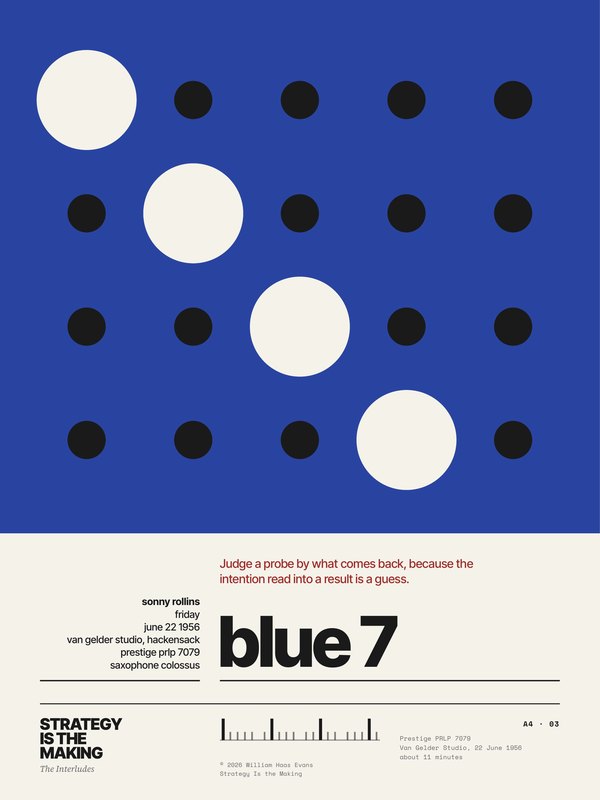
One cell, with its accent moved a single position each time the figure returns. The displacement is the whole mark.
The music
He works a compact figure, turns it, displaces it, alters its contour, and lets each variation propose the next.
From The Interludes. Position along the line is time and height is stress. How to read a mark · Download The Interludes (PDF)
The poster
Judge a probe by what comes back, because the intention read into a result is a guess.
The record
Sonny Rollins. “Blue 7,” on Saxophone Colossus. Prestige PRLP 7079, 1957. Recorded at Van Gelder Studio, Hackensack, New Jersey, 22 June 1956. Rollins (tenor saxophone), Tommy Flanagan (piano), Doug Watkins (bass), Max Roach (drums). Composed by Sonny Rollins. Approximately 11:17.
Sonny Rollins, “Blue 7,” on Saxophone Colossus (Prestige PRLP 7079, 1957). Gunther Schuller, “Sonny Rollins and the Challenge of Thematic Improvisation,” The Jazz Review 1, no. 1 (November 1958): 6–11, 21; and Benjamin Givan, “Gunther Schuller and the Challenge of Sonny Rollins,” Journal of the American Musicological Society 67, no. 1 (2014): 167–237.