Chapter 05
Time as Material
Jazz Interlude · 03
Dave Brubeck Quartet
Blue Rondo à la Turk
Dave Brubeck Quartet. “Blue Rondo à la Turk,” on Time Out. Columbia CL 1397 (mono) / CS 8192 (stereo), released 14 December 1959. Recorded at Columbia 30th Street Studio, New York, 18 August 1959, the third of the three Time Out sessions; producer Teo Macero. Dave Brubeck (piano), Paul Desmond (alto saxophone), Eugene Wright (bass), Joe Morello (drums). Composed by Dave Brubeck. Track one, side one. 6:44.
Temporal capability composes more than one clock
A rhythm people stop counting stops being seen as a choice, so decide which tempos to absorb and which to keep visible.
Listen
Recorded at Columbia’s 30th Street Studio, New York, on 18 August 1959.
Recorded 18 August 1959, Columbia 30th Street Studio, New York. Quartet. About six minutes forty-five.
In 1958, the United States Department of State sent the Dave Brubeck Quartet on a goodwill tour through Poland, Turkey, India, Ceylon, Pakistan, Iran, and Iraq, using jazz as soft power at the height of the Cold War. Walking to a radio broadcast in Istanbul, Brubeck heard street musicians playing a rhythm he could not count.
When Brubeck asked about it, a musician answered that the rhythm was to them what the blues was to Americans, an explanation Brubeck repeated for the rest of his life.
Listen for
The piece inhabits an odd meter that keeps changing the form of its oddness.
The limp
The rhythm consists of nine pulses grouped two, two, two, three. Turkish theory calls that limping asymmetry aksak, and karşılama, a dance from the Thracian northwest played at weddings, uses the same grouping. The street musicians experienced the rhythm as ordinary and easy, much as a twelve-bar blues is ordinary to an American bar band. Each culture carves the same phenomenon differently and finds the other’s carving difficult.
The walk
For three bars, the meter is nine-eight grouped two-two-two-three; a fourth bar regroups the same nine pulses as three-three-three; and the four-bar unit repeats. The pattern alternates three bars of limping with one bar of walking. The piece inhabits an odd meter that keeps changing the form of its oddness.
Two meters, neither defeated
The piece works because neither meter defeats the other. Brubeck keeps the limp in the nine and lets the blues swing in a steady four, placing two ways of counting time beside one another without ranking them. Most American popular music, jazz and blues included, is counted in four beats to the bar, so a listener raised on it hears the blues section as home and the nine as the strange part. A listener raised on the wedding dances of Thrace, where the limping nine is ordinary, hears the same record the other way around: the nine is home and the blues is the departure. The record does not change between them. What sounds normal depends on what each listener has heard repeated.
The nine then begins to alternate with a straight four-four, and the four-four opens into a blues over which the band solos. After the solos the alternation returns, and the nine comes back to close the record.
Columbia hesitated over the unusual time signatures, and the label’s president approved release only after the quartet agreed to record an album of standards first. The caution was commercially reasonable and proved inaccurate: Time Out sold half a million copies within four years and is now certified double platinum. Brubeck was later criticized for having become commercial.
The exchange also carried an ethical asymmetry. The tour was state-sponsored, the borrowing moved in one direction, and the Istanbul musicians received neither names on the record nor royalties. Brubeck’s account of the exchange is real, and so is the unequal structure in which it occurred.
The same album made the strange meter ordinary. “Take Five” was recorded on 1 July 1959 at the same sessions, and the saxophonist Paul Desmond wrote it because the drummer Joe Morello wanted a piece in five that would let him solo in the meter he had been playing on the bandstand. The piece is a vamp in five-four with a melody that a listener can hum after one hearing, and that is the whole design. The five never resolves into four. It stays five for the entire performance and the listener stops noticing, which is the opposite of what “Blue Rondo” does. Columbia issued it as a single in September 1959, reissued it in May 1961, and it reached the Billboard Hot 100 that autumn and went on to become the first jazz single to sell a million copies.
Desmond’s own long horizon sits inside the piece. When he died in 1977 his will directed the royalties from “Take Five” and his other compositions to the American Red Cross, which has since received more than $6 million from the bequest and continues to receive more than $100,000 a year. A five-minute vamp written to give a drummer something to solo over has been funding disaster relief for half a century.
The follow-up kept the meter difficult on purpose. “Unsquare Dance,” from Time Further Out in 1961, runs two minutes in seven-four over a bass figure, handclaps, and the rim of a snare drum, with the piano entering late. Brubeck wrote it on the way to the studio and the quartet recorded it the same day. He described it as “deceitfully simple,” said it “refuses to be squared,” and called it “a challenge to the foot-tappers, finger-snappers and hand-clappers.” The laugh at the end of the record is Morello’s, which Brubeck explained as a guffaw of surprise and relief that they had managed to get through the difficult last chorus.
That laugh is the honest sound of a tempo that was never allowed to become comfortable.
From Chapter 05, “Time as Material”
Two clocks
An organization that says it runs two clocks usually runs one and tolerates the other, and the tell is which one gets rescheduled when they collide.
An organization that says it runs two clocks usually runs one and tolerates the other, and the tell is which one gets rescheduled when they collide. This record is the rarer arrangement. The nine and the four alternate in shrinking blocks, each keeping its own integrity, and neither is treated as the exception the other has to accommodate. That costs something. The band had to play both convincingly, the label had to be persuaded to carry the risk, and the persuading took an entire album of standards as collateral.
The organizational version of “Take Five” is a new rhythm that people stop experiencing as new. A release cadence, a review cycle, or a budgeting rhythm that at first feels wrong becomes the way work is done, and the point at which nobody counts anymore is the point at which it has been absorbed. Absorption is the goal and it carries a cost that “Blue Rondo” does not: once the five is ordinary, nobody hears it as a choice, and the organization forgets that it could have chosen otherwise.
That laugh is the honest sound of a tempo that was never allowed to become comfortable. “Take Five” lets the listener stop counting. “Unsquare Dance” makes the listener clap along in seven and keeps the difficulty live to the final bar, and the drummer who had played in five every night for two years was still relieved to reach the end. An organization that wants a rhythm to stay visible, so that people keep choosing it instead of falling into it, is asking for “Unsquare Dance” and should expect the same relief at the end of every chorus. Both designs are legitimate. The mistake is to want the second while building the first.
The lesson: A rhythm people stop counting stops being seen as a choice, so decide which tempos to absorb and which to keep visible.
The mark · V · 03
In the making
Chapter 05 places the record in “Temporal capability composes more than one clock.” Two temporal systems coexisting without one becoming subordinate. Nine pulses grouped two-two-two-three alternate with a bar grouped three-three-three, then with a four-four blues, and neither meter is treated as the exception the other accommodates. “Take Five” and “Unsquare Dance” show the other two choices: a meter made ordinary and a meter kept alive.
The mark
Nine pulses grouped two, two, two and three for three bars. The fourth bar regroups the same nine as three, three and three, and the unit repeats.
The music
For three bars, the meter is nine-eight grouped two-two-two-three; a fourth bar regroups the same nine pulses as three-three-three; and the four-bar unit repeats.
From The Interludes. Position along the line is time and height is stress. How to read a mark · Download The Interludes (PDF)
The poster
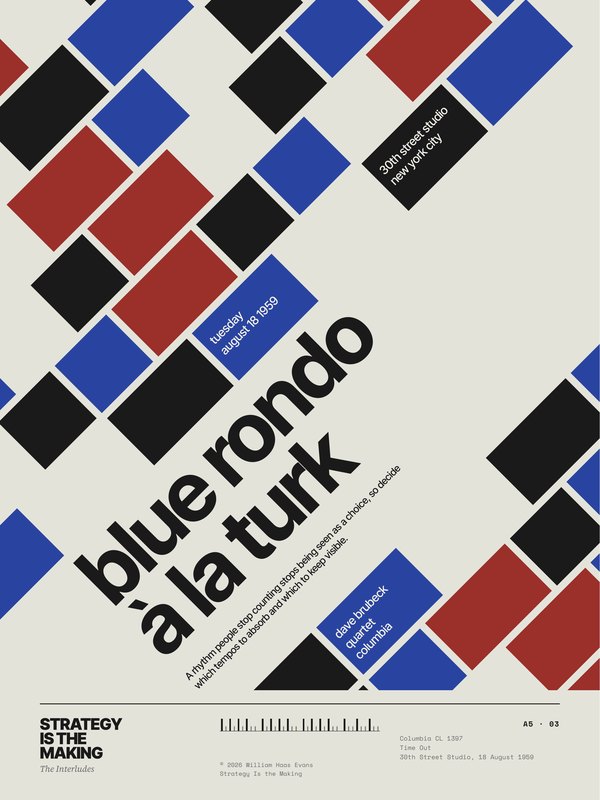
A rhythm people stop counting stops being seen as a choice, so decide which tempos to absorb and which to keep visible.
The record
Dave Brubeck Quartet. “Blue Rondo à la Turk,” on Time Out. Columbia CL 1397 (mono) / CS 8192 (stereo), released 14 December 1959. Recorded at Columbia 30th Street Studio, New York, 18 August 1959, the third of the three Time Out sessions; producer Teo Macero. Dave Brubeck (piano), Paul Desmond (alto saxophone), Eugene Wright (bass), Joe Morello (drums). Composed by Dave Brubeck. Track one, side one. 6:44.
Brubeck gave his account of the Istanbul encounter in interviews over many years, and it is recorded in Hedrick Smith’s documentary Rediscovering Dave Brubeck, PBS, 2001. The wording that circulates most widely, “This rhythm is to us what the blues is to you,” derives from that account. Constantin Brăiloiu, “Le rythme aksak,” Revue de Musicologie 33 (1951): 71–108, on the limping additive meter. Karşılama is a nine-eight dance of northwestern Turkey, grouped 2+2+2+3, danced at weddings and festivals. Stephen A. Crist, “Time Out: The Dave Brubeck Quartet (1959),” essay for the National Recording Preservation Board, Library of Congress, on the album’s addition to the National Recording Registry. https://www.loc.gov/static/programs/national-recording-preservation-board/documents/TimeOut.pdf. Crist describes the four-bar unit as three measures grouped 2+2+2+3 followed by one of 3+3+3. Columbia hesitated over the album’s unusual time signatures. Label president Goddard Lieberson approved release on condition that the quartet first record Gone with the Wind, an album of standards. Time Out had sold more than 500,000 copies by 1963. RIAA platinum 1997; double platinum certified February 2011, for sales above two million. “Take Five,” composed by Paul Desmond, was recorded on 1 July 1959 at Columbia’s 30th Street Studio during the Time Out sessions and runs 5:24 on the album. Columbia issued it as a single on 21 September 1959 and reissued it on 22 May 1961; it reached number 25 on the Billboard Hot 100 in October 1961 and became the first jazz single to sell a million copies. Morello’s wish for a piece in five-four is the standard account of the composition’s origin. Paul Desmond died on 30 May 1977. His will assigned the royalties from “Take Five” and his other compositions to the American Red Cross, which reports more than $6 million received from the bequest and more than $100,000 a year. “Unsquare Dance,” composed by Dave Brubeck, recorded in 1961 and issued on Time Further Out (Columbia, 1961) and as a single; 2:00. Brubeck’s liner note calls the piece “deceitfully simple” and “a challenge to the foot-tappers, finger-snappers and hand-clappers,” and identifies the laugh at the end as Joe Morello’s.