Chapter 06
Designing Transitions
Jazz Interlude · Prelude
Ornette Coleman Quartet
Lonely Woman
Ornette Coleman Quartet. “Lonely Woman,” on The Shape of Jazz to Come. Atlantic 1317, 1959. Composed by Ornette Coleman. Recorded at Radio Recorders, Los Angeles, 22 May 1959; produced by Nesuhi Ertegun. Coleman (alto saxophone), Don Cherry (cornet), Charlie Haden (bass), Billy Higgins (drums). 4:59.
Prelude · Closing the distance between decision, outcome, and insight
Parts of one system can run at different rates when they meet at a few fixed points and listen in between.
Listen
Recorded at Radio Recorders, Los Angeles, on 22 May 1959.
The quartet recorded it at Radio Recorders in Los Angeles on 22 May 1959, with Nesuhi Ertegun producing for Atlantic, and it opens The Shape of Jazz to Come. Coleman played alto saxophone, Cherry cornet, Haden bass, and Higgins drums. The performance lasts four minutes and fifty-nine seconds. No piano or guitar appears anywhere on it, so nothing states the harmony and nothing marks the beat on anyone else’s behalf.
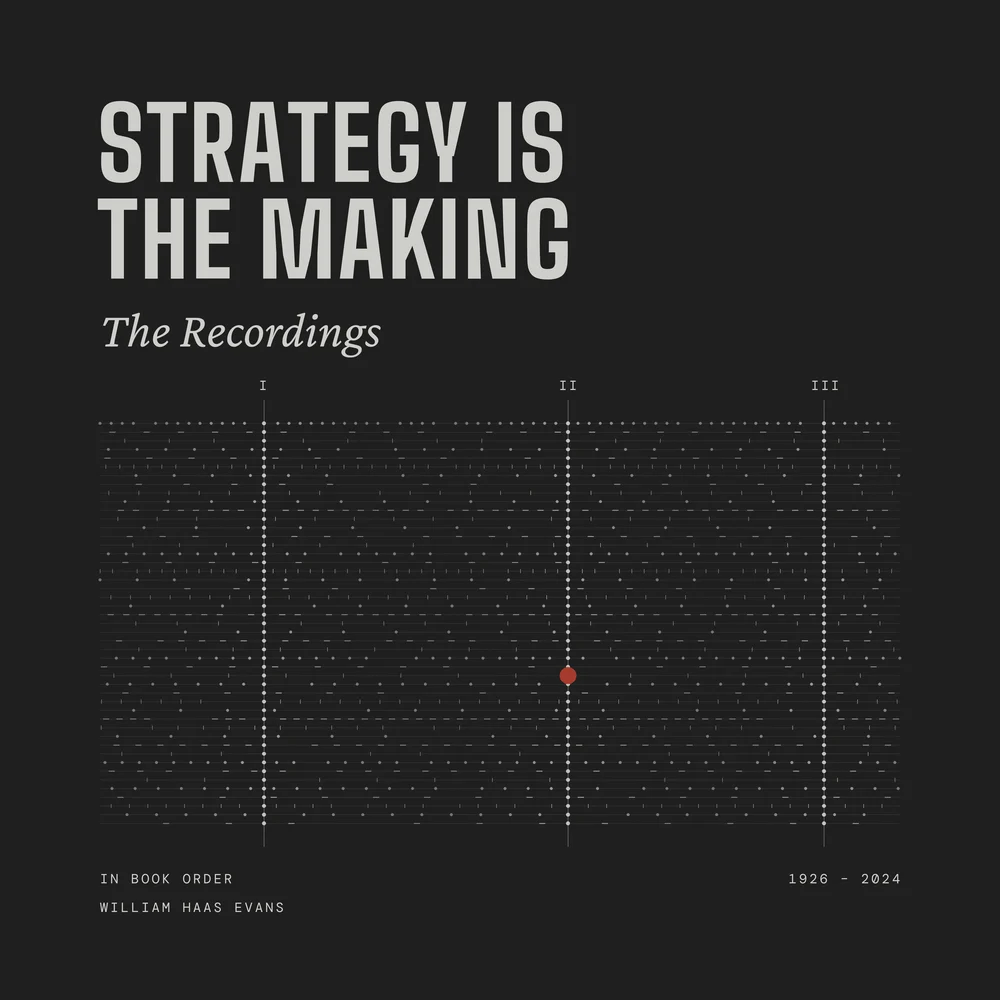
Listen for
The players arrive together at the points that matter and are apart everywhere else.
Three rates at once
Billy Higgins opens alone at a fast bebop clip. Charlie Haden comes in underneath him at a different rate. Then Ornette Coleman and Don Cherry state the melody on top, slow and unhurried, and the three layers run at once without ever agreeing on a beat.
Four readings of the meter
The published analysis puts the horns near 120 to the minute and the drums between 299 and 337, settling around 325, a ratio of roughly eight to three. Four transcribers have published four different readings of the meter. Gunther Schuller wrote it in cut time at about 88 in 1961. Steven Block wrote it in four at 186 in 1990 and left the B section out. Lynette Westendorf wrote it in cut time at about 84 in 1994 and said in print that her transcription was an approximation of reality. A fourth reading from 2009 gives four at about 160.
Listening instead of counting
There is no fixed chorus length to return to and no shared pulse to fall back on. The performance stays together because each musician can hear where the others are without being told. The coordination is continuous and local rather than episodic and centralized, which is a different thing from playing freely. On “Your Lady,” one drummer coordinated two pulses around a common rhythmic reference. Here the pulses belong to different people, and that reference emerges through their listening and response to one another.
Nothing about the session suggests a click or any other synchronizing device, and none of the four players left an account of how they stayed together. The players arrive together at the points that matter and are apart everywhere else.
A team told only that another team is amber on a dashboard has been given the schedule and denied the sound.
From Chapter 06, “Designing Transitions”
The calendar and the click track
A shared calendar works like a click track.
An organization in transition is in this position and usually denies it. Different parts of the business are running at different rates by necessity. The part serving today’s customers cannot slow down. The part building the replacement cannot move at the speed of quarterly reporting. The part deciding what to retire moves slower than either. The common response is to put every part on one calendar and call the calendar alignment.
A shared calendar works like a click track. It produces the appearance of coordination by forcing every part to the same rate, which throttles the fast part and rushes the slow one. Name the points where the parts must arrive together, treat those as fixed, and let the rates differ in between. The horns and the drums meet at the phrase boundaries, and between those boundaries nobody is counting for anybody.
The alternative costs something the calendar does not. Each part has to be able to hear the others continuously, which means real information about what the other parts are doing rather than a report on whether they are on schedule. Higgins can play at 325 against a melody at 120 because he can hear the melody. A team told only that another team is amber on a dashboard has been given the schedule and denied the sound.
The meeting points have to be few enough to serve coordination without obstructing the work. Coleman’s quartet uses the melody and the beginnings and endings of phrases as shared points of reference, leaving room for independent movement between them. An organization that makes forty milestones occasions for joint synchronization creates a thicket of dependencies. Work ready to proceed waits for other work still developing, queues build at those junctions, and delays spread through the system. The discipline is to identify the few points where interdependent contributions genuinely need to meet, while allowing each part to move at the pace its work requires between them.
The lesson: Parts of one system can run at different rates when they meet at a few fixed points and listen in between.
The mark · VI · 00
In the making
Chapter 06 places the record in “Prelude · Closing the distance between decision, outcome, and insight.” Parts of one system running at different rates and remaining a system. The horns sit near 120 beats a minute and the drums near 325, four transcribers have published four different readings of the meter, and there is no piano to state harmony and no fixed chorus to return to. The players arrive together at the phrase boundaries and are apart everywhere else.
The mark
Three rows at three rates. The horns near a hundred and twenty to the minute, the drums near three hundred and twenty, and the bass between them. The ratio is drawn from Lindsay Vickery and Stuart James, ‘The Enduring Temporal Mystery of Ornette Coleman’s Lonely Woman’, which reports the drums between 299 and 337 and settling near 325.
The music
Higgins can play at 325 against a melody at 120 because he can hear the melody.
From The Interludes. Position along the line is time and height is stress. How to read a mark · Download The Interludes (PDF)

The poster
Parts of one system can run at different rates when they meet at a few fixed points and listen in between.
The record
Ornette Coleman Quartet. “Lonely Woman,” on The Shape of Jazz to Come. Atlantic 1317, 1959. Composed by Ornette Coleman. Recorded at Radio Recorders, Los Angeles, 22 May 1959; produced by Nesuhi Ertegun. Coleman (alto saxophone), Don Cherry (cornet), Charlie Haden (bass), Billy Higgins (drums). 4:59.
Ornette Coleman Quartet, “Lonely Woman,” recorded 22 May 1959 at Radio Recorders, Los Angeles, produced by Nesuhi Ertegun, issued on The Shape of Jazz to Come (Atlantic 1317). The 4:59 timing is the album label’s. Lindsay Vickery and Stuart James, “The Enduring Temporal Mystery of Ornette Coleman’s ‘Lonely Woman’” (Western Australian Academy of Performing Arts, Edith Cowan University), 49–63. The paper puts the horns near 120 beats per minute and the drums between 299 and 337, with a mean near 325 and stabilization near 327, and identifies an eight-to-three metric relationship as the most common proportion. The four transcriptions compared are Schuller (1961), Block (1990), Westendorf (1994), and Ville (2009).