Chapter 01
The Great Unraveling
Jazz Interlude · Prelude
Ahmad Jamal Trio
Poinciana
Ahmad Jamal Trio. “Poinciana,” on Ahmad Jamal at the Pershing: But Not for Me. Argo LP-628, 1958. Recorded live at the Pershing Lounge, Chicago, 16 January 1958. Ahmad Jamal (piano), Israel Crosby (bass), Vernel Fournier (drums). 7:35.
Prelude · The room remains lit after the city has gone dark
An interior can be fully ordered and tell you nothing about the street.
Listen
Recorded live at the Pershing Lounge, Chicago, on 16 January 1958.
The Ahmad Jamal Trio recorded “Poinciana” on 16 January 1958 at the Pershing Lounge, a room inside the Pershing Hotel on Chicago’s South Side. Dave Usher produced and Malcolm Chisholm engineered. Israel Crosby played bass, on an unamplified student instrument, and Vernel Fournier played drums. Argo issued the album that year as LP-628 under the title At the Pershing: But Not for Me.
Nat Simon and Buddy Bernier wrote the song in 1936, adapting a Cuban folk melody, and by 1958 it was ordinary repertoire that any working trio could be expected to know. What this trio does with it is a rhythm.
Listen for
What this trio does with it is a rhythm.
Vernel Fournier, drums
From a New Orleans street beat called the Two-Way-Pocky-Way, Fournier designed the drum pattern that drives the recording, adapting a two-beat conga pattern the trio’s former guitarist had played. The bass drum sets the pulse, with the cymbal moving above it. Fournier keeps the rhythm recognizable while changing its sound: he moves between stick and mallet, shifts from hi-hat to crash cymbal, and adds rimshots as the choruses accumulate.
Ahmad Jamal, piano
Above it, Jamal leaves most of the room empty. He states a few notes of the melody and drops out. He sets forte against pianissimo across single phrases. He suspends the song’s form for stretches where the harmony stops moving and the trio simply settles into a vamp. The silences are placed as deliberately as the notes, and the pattern underneath continues while he is gone.
Israel Crosby, bass
Crosby is doing the work that makes the silences safe. An unamplified bass in a hotel lounge has to carry the harmony at low volume for a room with tables in it, which leaves no margin for imprecision. The trio can play this quietly because all three parts are exact. Quiet playing is usually heard as relaxed. It is the least forgiving dynamic available, because nothing covers anything.
The album stayed on the Billboard chart for over a hundred weeks and passed a million copies, which is an unusual reception for a piano trio playing quietly. Miles Davis brought Red Garland, Paul Chambers, and Philly Joe Jones to hear the trio, and said later that Jamal had knocked him out with his concept of space, his lightness of touch, and his understatement.
The light in the diner is as bright as it ever was.
From the Prelude, “The room remains lit after the city has gone dark”
The interior and the street
An organization whose internal signals are all consistent, all positive, and all generated inside its own operating model has built an instrument that measures itself.
The order in the performance is total. Every element is placed, the rhythm is exact, the dynamics are controlled, and nothing is loud or loose. That order is what makes the space around it audible, because a listener can only hear an absence against something reliable enough to be missing from.
An organization can achieve the same interior. Processes fit, the calendar runs, the numbers arrive on time, and everyone inside can hear how well it is working. The quality of the internal order carries no information at all about the conditions outside it. A trio playing with this much control in a hotel lounge in January 1958 was three years from a music that would abandon most of what it depended on, and nothing audible in the room announced that.
The test is where the disconfirming signal would have to come from. If every measure an organization trusts is produced by the operating model being measured, the model cannot report its own obsolescence. Something has to be listening to the street, and it has to be something the interior does not control.
The lesson: An interior can be fully ordered and tell you nothing about the street.
The mark · I · 00
In the making
Chapter 01 places the record in “Prelude · The room remains lit after the city has gone dark.” Total internal order carrying no information about external conditions. The trio’s control is exact, the silences are audible because the pattern underneath is reliable, and nothing in the room reports that the music is three years from abandoning what it depends on. An organization whose every measure is produced by the model being measured has built an instrument that measures itself.
The mark
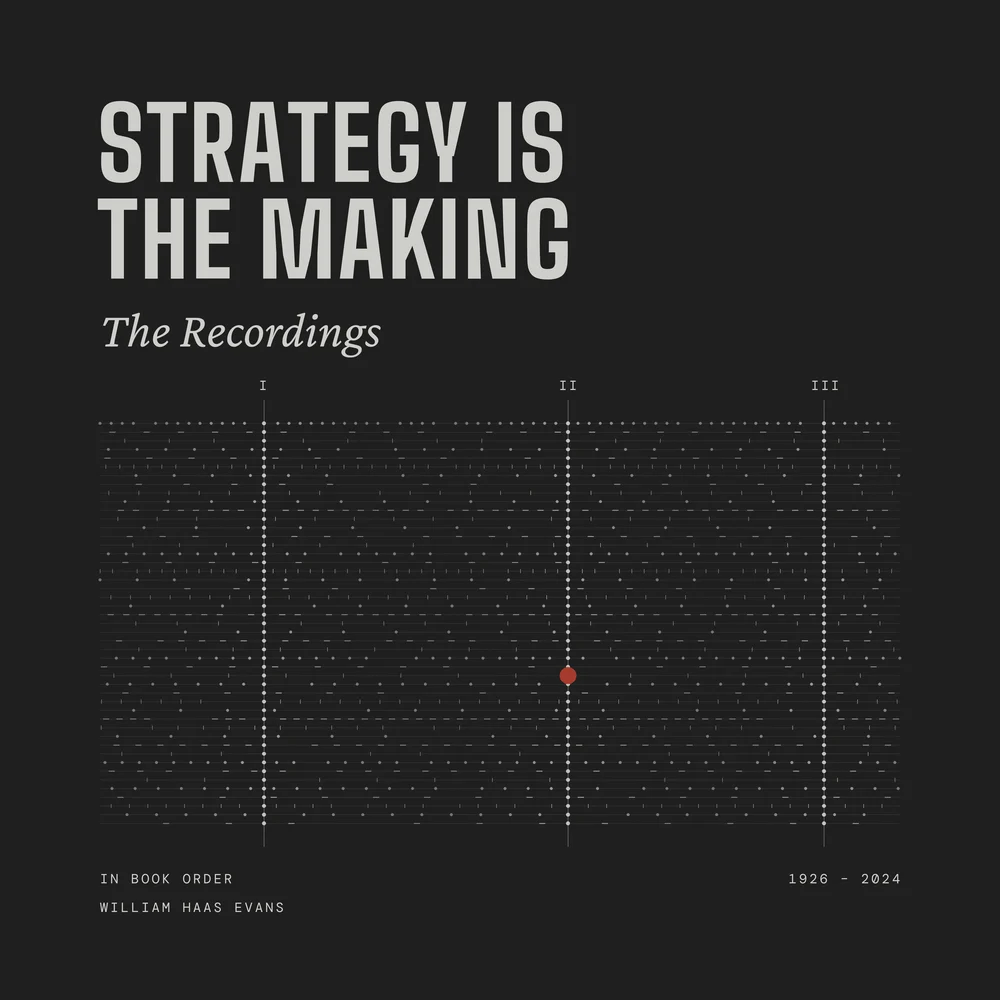
A ground carrying one pulse for each minute of the performance, with the sparse events above it. The pulse count is a reading and waits on a timing of the record.
The music
The trio can play this quietly because all three parts are exact.
From The Interludes. Position along the line is time and height is stress. How to read a mark · Download The Interludes (PDF)
The poster
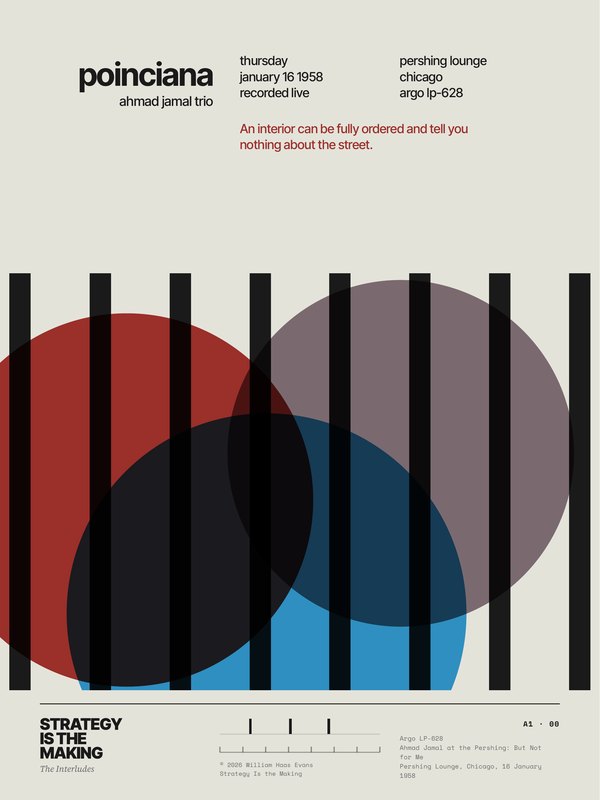
An interior can be fully ordered and tell you nothing about the street.
The record
Ahmad Jamal Trio. “Poinciana,” on Ahmad Jamal at the Pershing: But Not for Me. Argo LP-628, 1958. Recorded live at the Pershing Lounge, Chicago, 16 January 1958. Ahmad Jamal (piano), Israel Crosby (bass), Vernel Fournier (drums). 7:35.
Ahmad Jamal Trio, “Poinciana,” recorded 16 January 1958 at the Pershing Lounge, Chicago. Jamal (piano), Israel Crosby (bass), Vernel Fournier (drums); producer Dave Usher, engineer Malcolm Chisholm. At the Pershing: But Not for Me, Argo LP-628, 1958. Song by Nat Simon and Buddy Bernier, 1936, adapted from a Cuban folk melody. Fournier on the Two-Way-Pocky-Way origin of the figure, and on his variation of it across the take, from his 1990 WKCR interview with Ted Panken and from Stuart Nicholson’s account of the Pershing sessions. Chart longevity and sales from Nicholson and from the National Endowment for the Arts Jazz Masters record. Miles Davis on Jamal’s use of space, from Miles: The Autobiography.