Chapter 06
Designing Transitions
Jazz Interlude · 04
Stan Getz and João Gilberto with Astrud Gilberto
The Girl from Ipanema
Stan Getz and João Gilberto with Astrud Gilberto. “The Girl from Ipanema,” on Getz/Gilberto. Verve V-8545 (mono) and V6-8545 (stereo), released March 1964. Composed by Antônio Carlos Jobim, Portuguese lyric by Vinícius de Moraes. Recorded at A&R Recording, New York, 18 and 19 March 1963; produced by Creed Taylor. Album version 5:24. The single edit, Verve VK-10323, runs about 2:44. Awarded the Grammy for Record of the Year, 1965.
Scale begins by identifying what the protection produced
The channels that carry an innovation to scale select what survives the trip, and they alter its duration, language, credit, and meaning.
Listen
Recorded at A&R Recording, New York, on 18 and 19 March 1963.
They recorded it at A&R Recording in New York on 18 and 19 March 1963, with Creed Taylor producing and Phil Ramone engineering, and Verve released the album in March 1964. Jobim wrote the music in 1962 and Norman Gimbel wrote the English lyric. Astrud Gilberto was at the session because she was married to João. She was not a professional singer and had not been booked to sing.
The album version begins with João Gilberto singing Vinícius de Moraes’s Portuguese lyric. Astrud Gilberto follows in English, her cool, untrained voice entering beside Antônio Carlos Jobim’s piano and Stan Getz’s tenor. The track runs five minutes and twenty-four seconds on the Verve pressing and fits two languages, two singers, and a long instrumental passage inside one quiet pulse.
Listen for
What traveled through American radio was a transformed version of what had been made, cut to the length and the language of a different selection environment.
An unplanned vocal
Accounts of how she came to sing do not agree. Ramone, who was in the room, said Taylor wanted an English version, looked around, and Astrud volunteered. Astrud’s own recollection was that João announced a surprise and had her sing at a rehearsal. The historian Ruy Castro says the idea was hers and that João hesitated. Taylor’s account has him noticing her singing along. Five versions circulate. They agree on one point: the English vocal was unplanned, and it was sung by someone who happened to be in the room.
The single edit
The single edit removed João’s Portuguese verse and reduced the record to under three minutes. Astrud became the sole singer. What traveled through American radio was a transformed version of what had been made, cut to the length and the language of a different selection environment.
Reach, credit and money
Credit and money moved differently from reach. The album is credited to Stan Getz and João Gilberto featuring Antônio Carlos Jobim. Astrud is reported to have received a flat session fee. She called the arrangement she toured under a slave salary, and she and Getz stopped working together in December 1964 after an argument about her wages.
The edit worked. The single reached number five on the Billboard Hot 100 in the summer of 1964 and number twenty-nine in Britain. At the Grammy ceremony in April 1965 it won Record of the Year, credited to Stan Getz and Astrud Gilberto, while the album won Album of the Year, credited to Getz and João Gilberto. The record that made Astrud’s name is the one that removed her husband’s voice, and the album carrying her performance did not bill her among its artists.
Bossa nova was itself a transition in Brazilian music, built from samba, harmonic language associated with jazz, and a quieter vocal and rhythmic conception. The American hit stabilized one version of that transition for a global audience. The version that scaled became the version through which many listeners understood the form.
Each channel that carries an innovation outward is a filter with criteria of its own, and it edits what passes through.
From Chapter 06, “Designing Transitions”
What survives the trip
The way to see it is to compare what went in against what came out, item by item.
Each channel that carries an innovation outward is a filter with criteria of its own, and it edits what passes through. A pilot that succeeds inside an organization gets rewritten by the channels that carry it outward: the compliance review, the standard contract, the sales script, the reporting template. Each of those has a duration and a language, as radio did, and each removes what will not fit. The organization then evaluates the innovation by what came out the far end and concludes the pilot was overrated.
The filtering is invisible from inside because each edit makes sense on its own terms. The action was a track shortened to fit a radio format, and the removal of the Portuguese verse followed from the format rather than from any decision about the verse. Every gate an innovation passes through inside an organization has the same character: a reasonable local rule, applied by someone doing their job correctly, whose aggregate effect nobody owns. The way to see it is to compare what went in against what came out, item by item.
The lesson: The channels that carry an innovation to scale select what survives the trip, and they alter its duration, language, credit, and meaning.
The mark · VI · 04
In the making
Chapter 06 places the record in “Scale begins by identifying what the protection produced.” Channels of scale operating as filters with criteria of their own. The single edit removed the Portuguese verse and cut the track to under three minutes for radio, and what traveled was a transformed version, cut to the duration and language of a different selection environment. Credit and money moved differently from reach.
The mark
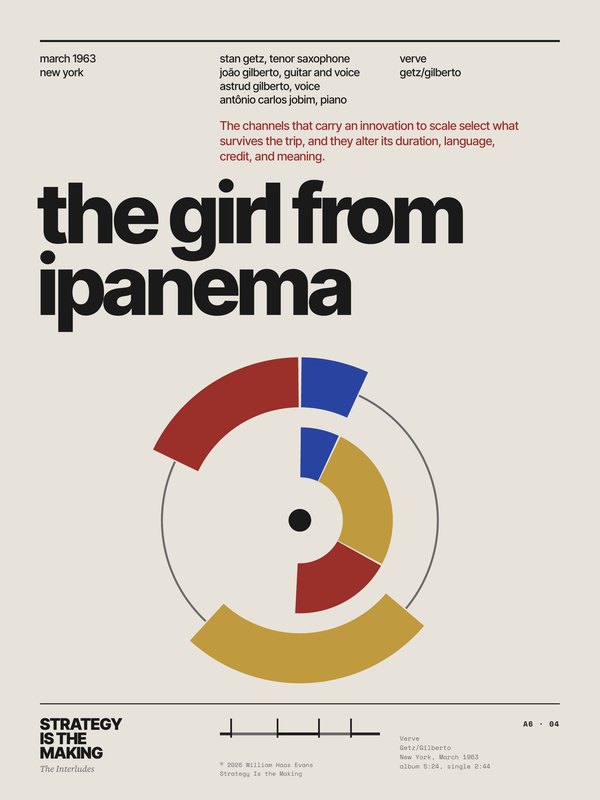
The faint spans are what the single edit removed, and they come to just under half the record. Album 5:24 against a single of about 2:44.
The music
The album version begins with João Gilberto singing Vinícius de Moraes’s Portuguese lyric.
From The Interludes. Position along the line is time and height is stress. How to read a mark · Download The Interludes (PDF)
The poster
The channels that carry an innovation to scale select what survives the trip, and they alter its duration, language, credit, and meaning.
The record
Stan Getz and João Gilberto with Astrud Gilberto. “The Girl from Ipanema,” on Getz/Gilberto. Verve V-8545 (mono) and V6-8545 (stereo), released March 1964. Composed by Antônio Carlos Jobim, Portuguese lyric by Vinícius de Moraes. Recorded at A&R Recording, New York, 18 and 19 March 1963; produced by Creed Taylor. Album version 5:24. The single edit, Verve VK-10323, runs about 2:44. Awarded the Grammy for Record of the Year, 1965.
The five accounts are: Phil Ramone, interviewed by Marc Myers, JazzWax, 10 November 2010; Astrud Gilberto’s own recollection; Ruy Castro’s history of bossa nova; Creed Taylor’s account at ctproduced.com; and Carrie Kahn, All Things Considered, National Public Radio, 6 June 2023. Stan Getz and João Gilberto, Getz/Gilberto, recorded 18–19 March 1963 and released by Verve in 1964. The comparison uses the 5:24 album track as timed on the Verve label and the shortened single edit. Chart placings from Billboard and, for the United Kingdom, the Official Charts Company. Grammy credits from the Recording Academy record of the 7th Annual Grammy Awards, 13 April 1965, which lists Record of the Year to Stan Getz and Astrud Gilberto and Album of the Year to Stan Getz and João Gilberto.