Chapter 04
Navigating Uncertainty
Jazz Interlude · 01
Keith Jarrett
The Köln Concert, Part I
Keith Jarrett. The Köln Concert. ECM 1064/65, 1975. Recorded live at the Opernhaus Köln, 24 January 1975; produced by Manfred Eicher. Jarrett (solo piano). Part I approximately 26:00.
I · Negative capability keeps inquiry open under pressure
Uncertainty becomes manageable when attention turns from the missing instrument to the instrument present.
Listen
Recorded live at the Opernhaus Köln on 24 January 1975, alone at the piano.
Keith Jarrett, alone at the piano, played the Cologne Opera House on 24 January 1975, in a late slot scheduled after the evening’s opera. Vera Brandes had booked him as the fifth concert in a series she was promoting called New Jazz in Cologne. Manfred Eicher produced the recording for ECM Records.
Jarrett had driven overnight to get there, had slept badly for days, performed in a back brace, and came close to canceling before he sat down. The concert went ahead, and the label released it that November as a double album, with Part I running twenty-six minutes and the whole concert a little over sixty-six.
Hear Part I, all twenty-six minutes, on Keith Jarrett’s official YouTube channel.
Listen for
A different piano would have produced a different hour of music.
The wrong piano
The piano was the wrong piano. Jarrett had asked for a Bösendorfer 290 Imperial, a nine-and-a-half-foot concert grand with an extended bass. What the house supplied was a smaller Bösendorfer rehearsal instrument, out of tune, thin in the upper register, weak in the bass, with pedals that did not work properly. Moving a replacement across the city in cold rain was a risk of its own, so the instrument stayed. Tuners worked on it until it could be played.
What the left hand does
Long stretches of Part I sit on rolling left-hand ostinato figures and two-chord vamps, which put weight into a bass register that could not produce weight on its own. Eicher linked those choices to the piano’s limitations: “Probably he played it the way he did because it was not a good piano. He found another way to get the most out of it.” What a listener hears as Jarrett’s manner on this record is in part a response to the instrument’s faults. A different piano would have produced a different hour of music.
Following Part I
The progression of Part I can be followed without a transcription. Long passages unfold over a two-chord vamp between A minor seventh and G major, alternating between free time and a gospel-inflected pulse, before the music settles for several minutes on a theme in A major. A vamp is a repeating harmonic pattern that sustains motion without requiring a new harmonic destination. The pianist can repeat it in the left hand while developing melodic ideas in the right, creating continuity without relying on a powerful bass response.
Jarrett’s situation had four closed doors. He could not fix the instrument, could not substitute it, could not postpone, and could not know in advance whether the performance would come off. What remained open was the question of what this particular instrument could be made to do, and he stayed inside that question for sixty-six minutes.
Jarrett spent none of his attention on the instrument he had asked for.
From Chapter 04, “Navigating Uncertainty”
The instrument present
An organization under pressure usually treats a situation of that kind as a resourcing problem.
An organization under pressure usually treats a situation of that kind as a resourcing problem. The instrument is wrong, so the work waits until the right one arrives. Negative capability describes the other move, which is to keep working with attention on what is present. An unsuitable instrument and a concert that must happen together make a small, hard instance of the paradox of negative capability.
The discipline has a limit that the Cologne recording also shows. Jarrett could work with a bad piano because he had decades of preparation and because a piano, however poor, still produces pitches in a known relationship. A missing instrument is a different case from a defective one, and a defect that makes the work unsafe is a third case again. If the pedals had failed outright rather than intermittently, the case would point the other way. Deciding which case an organization is in has to be done from inside the room, by someone who can hear what the instrument will and will not do.
Jarrett spent none of his attention on the instrument he had asked for. A leadership team that spends its attention on the market it expected, the budget it was promised, or the team it planned to have is making the opposite allocation, and no amount of that attention changes what is in the room.
The lesson: Uncertainty becomes manageable when attention turns from the missing instrument to the instrument present.
The Dice Game
The Dice Game puts a leadership team in front of the instrument it has: the one step where its work piles up.
Play the Dice Game, freeThe mark · IV · 01
In the making
Chapter 04 places the record in “I · Negative capability keeps inquiry open under pressure.” Attention spent entirely on the instrument present. The piano was the wrong instrument, out of tune, thin on top, and weak in the bass, and the long left-hand ostinatos and two-chord vamps are in part a response to what it could not do. A different piano would have produced a different hour.
The mark
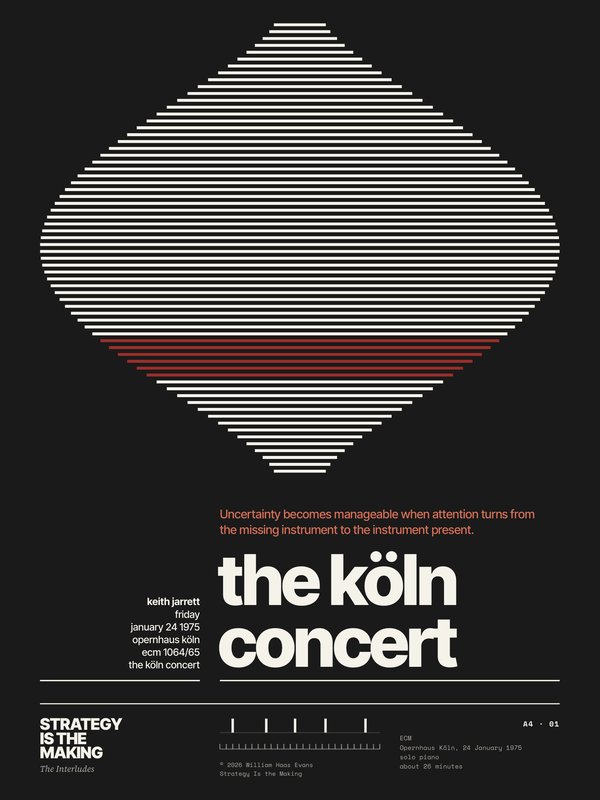
A ground carrying one pulse for each minute of Part I, with the right hand's events above it. The repeated left-hand figure is the ground.
The music
Long stretches of Part I sit on rolling left-hand ostinato figures and two-chord vamps, which put weight into a bass register that could not produce weight on its own.
From The Interludes. Position along the line is time and height is stress. How to read a mark · Download The Interludes (PDF)
The poster
Uncertainty becomes manageable when attention turns from the missing instrument to the instrument present.
The record
Keith Jarrett. The Köln Concert. ECM 1064/65, 1975. Recorded live at the Opernhaus Köln, 24 January 1975; produced by Manfred Eicher. Jarrett (solo piano). Part I approximately 26:00.
Keith Jarrett, The Köln Concert, recorded at the Opernhaus Köln, 24 January 1975; ECM Records, 1975.