Chapter 05
Time as Material
Jazz Interlude · 02
Max Roach
The Drum Also Waltzes
Max Roach. “The Drum Also Waltzes,” on Drums Unlimited. Atlantic 1467 (mono) / SD 1467 (stereo), 1966. Recorded in New York City, 14 October 1965; producer Arif Mardin. Roach (unaccompanied drum kit). Composed by Max Roach. 3:34.
Public witness can sustain a practice or hollow it out
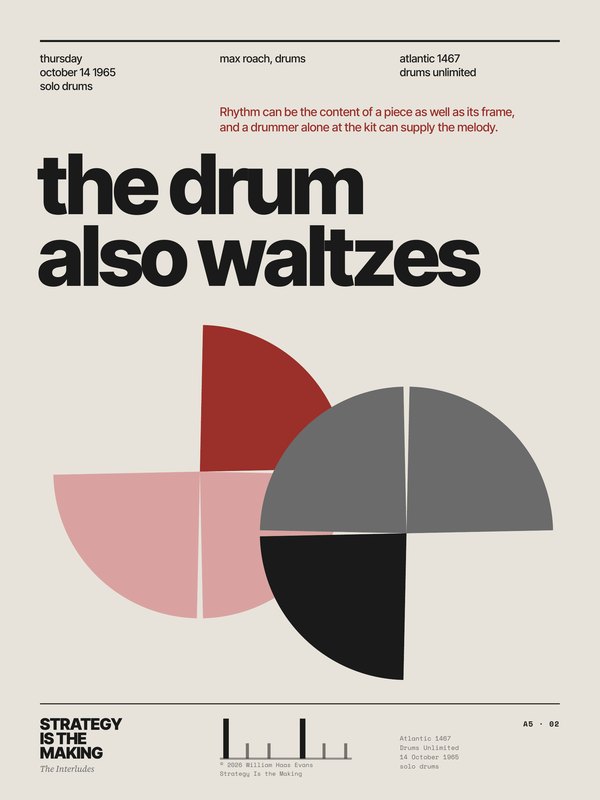
Rhythm can be the content of a piece as well as its frame, and a drummer alone at the kit can supply the melody.
Listen
Recorded in New York on 14 October 1965, with one drummer alone at the kit.
Recorded 14 October 1965. Released on Drums Unlimited (Atlantic, 1966). Solo drums.
A drum solo is often treated as a display of speed and stamina, which explains why many listeners stop attending to it. Roach makes something different: alone at the kit, he plays a waltz whose placement of beats carries the melody.
Listen for
Roach makes time carry the music and become the content.
Periods and question marks
Asked about his solos, Roach spoke of design. “It’s about design,” he said. “It isn’t about melody and harmony. It’s about periods and question marks.” Elsewhere he said a solo was design within the structure of something. The principles he named were architectural.
Four limbs, four voices
With no other instrument in the room, the placement of beats must establish the music’s structure. Each limb, he said, gives him a distinct voice, allowing him to orchestrate four rhythmic lines into conversation. He had never intended to be a timekeeper, because he felt the percussionist had more to say than that.
Room to breathe
“What makes it human is that it can breathe,” Roach told Down Beat in 1990. “The point being where you have to pause. And not only that, it also gives the lay people out there a chance to assimilate the statement you’ve made in sound, and enjoy it before you crowd ’em up with another thought.” The pause is the interval in which the audience catches up. Removing it adds no information and prevents what has already been sent from being taken in.
The piece outlived its own recording the way compositions do and drum features usually do not. Roach recorded it again in October 1984, nineteen years later and sixteen seconds shorter. The drummer Bill Bruford covered it the following year and said he did so because Roach had elegance, economy of movement, and a sense of architecture. The 2023 documentary about Roach’s life takes the piece for its title. A solo drum performance became a standard, which is only possible because Roach composed it as a fixed piece that other drummers could learn.
Two more solo pieces from the follow-up session in April 1966 were left in the can, one of them an unaccompanied reading of “’Round Midnight.” A drummer recording solo versions of standards in 1966 was doing something the instrument was not understood to do, and half of what he cut that day stayed unissued.
What makes it human is that it can breathe.
Max Roach, Down Beat, 1990
Timekeeping or structure
The same function defined as carrying structure produces different work from the same people, and the difference is audible before it is measurable.
Organizations commonly keep a function they treat the way listeners treat drum solos, as necessary support nobody attends to. Roach’s answer is that the conception of the role is the problem. A function defined as keeping time will be staffed, measured, and heard as timekeeping. The same function defined as carrying structure produces different work from the same people, and the difference is audible before it is measurable.
The lesson: Rhythm can be the content of a piece as well as its frame, and a drummer alone at the kit can supply the melody.
The mark · V · 02
In the making
Chapter 05 places the record in “Public witness can sustain a practice or hollow it out.” Time carrying structure rather than measuring it. With no other instrument in the room, the placement of beats has to establish the structure, and Roach describes the work as design, as periods and question marks. The pause is functional, because it gives listeners time to take in the statement.
The mark
Three-four, two bars. With nothing else to hold the tune, the placement of beats carries the melody.
The music
Each limb, he said, gives him a distinct voice, allowing him to orchestrate four rhythmic lines into conversation.
From The Interludes. Position along the line is time and height is stress. How to read a mark · Download The Interludes (PDF)
The poster
Rhythm can be the content of a piece as well as its frame, and a drummer alone at the kit can supply the melody.
The record
Max Roach. “The Drum Also Waltzes,” on Drums Unlimited. Atlantic 1467 (mono) / SD 1467 (stereo), 1966. Recorded in New York City, 14 October 1965; producer Arif Mardin. Roach (unaccompanied drum kit). Composed by Max Roach. 3:34.
“It’s about design […] periods and question marks” is quoted in Rick Mattingly’s Max Roach profile for the Percussive Arts Society Hall of Fame. “When I build a solo it’s design within the structure of something” is from Roach’s 1982 interview with Scott K. Fish. The statements about four limbs as four voices, and about not intending to be a timekeeper, are from John Ephland’s interview of 31 August 1990, Down Beat, November 1990, and from National Public Radio, 16 August 2007. Max Roach, interviewed by John Ephland, 31 August 1990, published Down Beat, November 1990. Roach re-recorded the piece on Survivors (Soul Note), recorded 19–21 October 1984, at 3:18 against the original 3:34. Bill Bruford’s version is on Flags with Patrick Moraz (1985); his reasons are given on his own published question-and-answer page. https://billbruford.com/faq/. Max Roach: The Drum Also Waltzes, directed by Sam Pollard and Ben Shapiro, premiered at South by Southwest in 2023 and aired on the Public Broadcasting Service on 6 October 2023.