Chapter 05
Time as Material
Jazz Interlude · 05
Tyshawn Sorey
Pillars
Tyshawn Sorey. Pillars. Firehouse 12 Records FH12-01-02-028, released 12 October 2018. Recorded 30 and 31 July 2017. Octet: Sorey (conductor, drum set, trombone, dungchen, percussion), Stephen Haynes, Ben Gerstein, Todd Neufeld, Joe Morris, Carl Testa, Mark Helias, Zach Rowden. Composed by Tyshawn Sorey. Three tracks, “Pillars I,” “Pillars II,” “Pillars III”; complete duration 3:50:19. https://firehouse12records.bandcamp.com/album/pillars
Coda · Two calendars make plural time ordinary
Deliberate slowness is a designed tempo, and some things are perceptible only at that rate.
Listen
Recorded 30 and 31 July 2017 by an octet, in three parts that run three hours and fifty minutes.
Recorded 30 and 31 July 2017. Electroacoustic octet. Three discs, three hours and fifty minutes.
Sorey’s nearly four-hour work resists use as background music and sits only partly within jazz. Very little appears to happen quickly, yet the deliberate slowness makes the event perceptible.
Pillars is not on Spotify, Apple Music or YouTube. Firehouse 12 Records sells it on CD and as a download at firehouse12records.bandcamp.com, and the fourth part, Pillars IV, on two LPs.
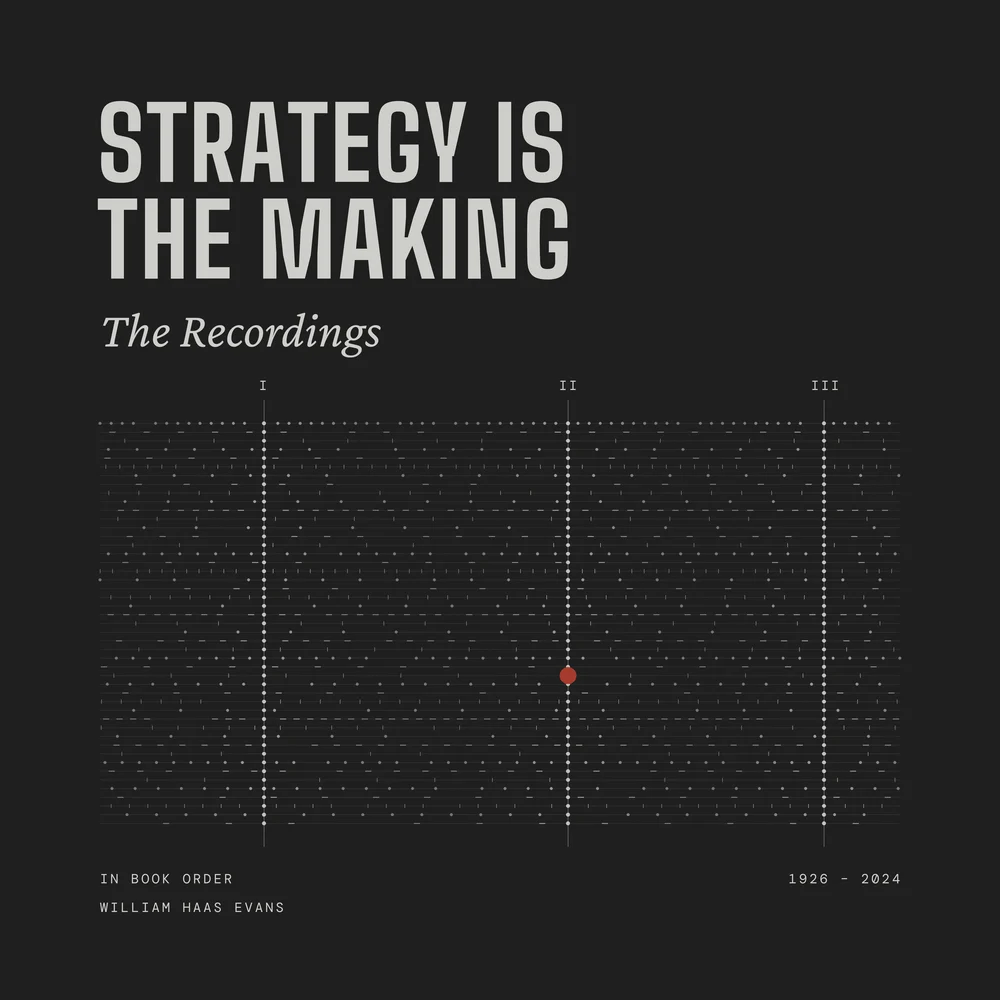
Listen for
Sounds arrive slowly enough for their arrival to become audible.
An ensemble built for duration
The ensemble is built for duration rather than for event. It has seven players besides Sorey: three on double bass, two on guitar, and two on brass, with the guitarist Joe Morris doubling on bass. Sorey conducts while playing drums, percussion, trombone, and a Tibetan long trumpet. The weight sits at the bottom, sustain is everywhere, and almost nothing in the instrumentation is designed to produce a fast attack.
Arrival made audible
Sounds arrive slowly enough for their arrival to become audible. Silences extend beyond comfort and continue. The work cannot be skimmed, and accelerated listening produces almost nothing, a property it shares with forests, cultures, and many of the organizational conditions that matter most.
More than the discs contain
There is more of it than the three discs contain. A fourth part, Pillars IV, was issued separately on two records and runs another ninety-five minutes. The sessions ran two days and the release credits an editor, so the four hours a listener experiences are not necessarily four hours that anybody played.
Critics divided on what the length asks of a listener. Two independent reviewers arrived at the same recommendation, that one should dip in and out rather than listen straight through. The critic Michael J. West, writing later, called the work a four-hour colossus that seems designed to tax the listener’s patience. Whether that is a complaint or a description depends on what you take the four hours to be for.
Sorey has since stepped back from work at this scale. “I’ve had my years of producing long CDs and long works and long processes,” he told Down Beat in 2023, describing a later piece that let him get away from it. Some things are perceptible only at a certain rate, and that rate is a choice. Length by itself is no achievement.
The institutions caught up. Sorey received a MacArthur Fellowship in 2017, the year these sessions were recorded, and the Pulitzer Prize for Music in 2024 for a saxophone concerto whose official citation describes “a wide range of textures presented in a slow tempo” and a work “treasuring intimacy rather than spectacle.” A prize committee wrote down that slowness was part of the achievement. Institutional judgment rarely runs in that direction, and it took about seven years.
Every argument for speed is incomplete. Its other half runs for nearly four hours and refuses to hurry for anyone.
From Chapter 05, “Time as Material”
A designed tempo
Some things are perceptible only at a certain rate, and that rate is a choice.
What the octet could not have done is coordinate the way a quartet does. Eight players keeping a shared center across a two-day session is a different problem from four players keeping one across a single track. An organization running a long program meets the same problem: the coordination that works across a quarter does not scale to a decade by being applied harder, and what replaces it is rarely written down.
The lesson: Deliberate slowness is a designed tempo, and some things are perceptible only at that rate.
The mark · V · 05
In the making
Chapter 05 places the record in “Coda · Two calendars make plural time ordinary.” Slowness as a designed tempo. The work runs nearly four hours, with an ensemble built for duration rather than event and silences that extend beyond comfort and continue. Accelerated listening produces almost nothing, which is a property it shares with forests and with many of the organizational conditions that matter most.
The mark
One event in the same window that holds twenty-five for Tatum.
The music
Sounds arrive slowly enough for their arrival to become audible. Silences extend beyond comfort and continue.
From The Interludes. Position along the line is time and height is stress. How to read a mark · Download The Interludes (PDF)
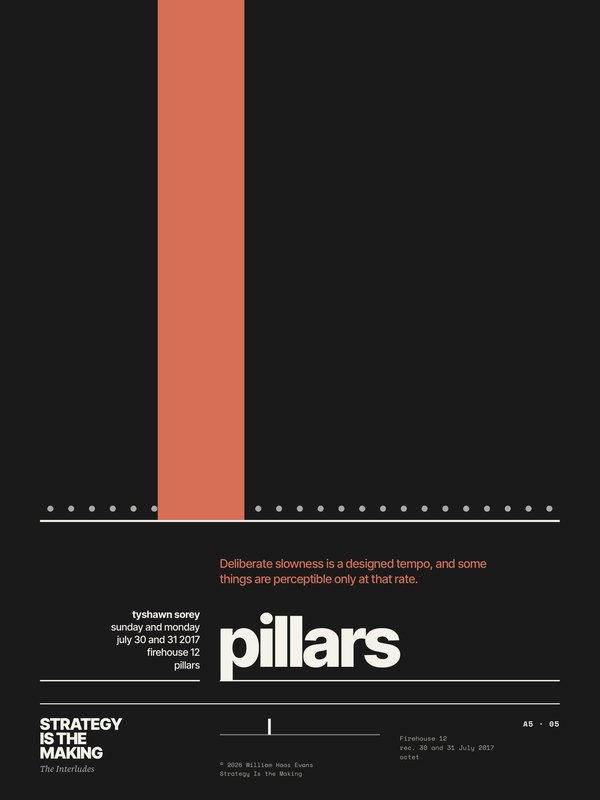
The poster
Deliberate slowness is a designed tempo, and some things are perceptible only at that rate.
The record
Tyshawn Sorey. Pillars. Firehouse 12 Records FH12-01-02-028, released 12 October 2018. Recorded 30 and 31 July 2017. Octet: Sorey (conductor, drum set, trombone, dungchen, percussion), Stephen Haynes, Ben Gerstein, Todd Neufeld, Joe Morris, Carl Testa, Mark Helias, Zach Rowden. Composed by Tyshawn Sorey. Three tracks, “Pillars I,” “Pillars II,” “Pillars III”; complete duration 3:50:19. https://firehouse12records.bandcamp.com/album/pillars
Hank Shteamer, review of Pillars, Rolling Stone, 23 October 2018, and Lee Rice Epstein, review of Pillars, The Free Jazz Collective, October 2018, both suggest dipping in and out rather than listening straight through. Michael J. West, “Tyshawn Sorey Loves to Confound,” Bandcamp Daily, 24 August 2022, calls it a four-hour colossus that seems designed to tax the listener’s patience. Pillars IV, Firehouse 12 FH12-01-08-028, two records, four parts totaling 1:35:28, from the same July 2017 sessions and personnel. Tyshawn Sorey, interviewed by Ted Panken, Down Beat, 6 September 2023. MacArthur Foundation, Fellows, Class of 2017. Pulitzer Prize for Music, 2024, for Adagio (For Wadada Leo Smith); the board’s citation describes “a wide range of textures presented in a slow tempo” and a work “treasuring intimacy rather than spectacle.”